Building a successful business requires more than just a great idea. Entrepreneurs need a structured way to validate assumptions, identify customer problems, and develop sustainable business models. One of the most popular frameworks for achieving this is the Lean Canvas.
Designed specifically for startups and innovative businesses, Lean Canvas simplifies business planning into a single-page document. Instead of creating lengthy traditional business plans, entrepreneurs can quickly map out their ideas, identify risks, and make improvements as they learn more about their customers and market.
Whether you are launching your first startup, developing a new product, or improving an existing business, Lean Canvas provides a practical framework for organizing ideas and making informed decisions.
This guide explains what Lean Canvas is, its components, benefits, examples, and how to create one effectively.
What Is Lean Canvas?
Lean Canvas is a one-page business planning framework developed by entrepreneur Ash Maurya. It adapts the traditional Business Model Canvas with a stronger focus on startup challenges, customer problems, and solution validation.
Rather than spending weeks writing detailed business plans, founders use Lean Canvas to summarize their business model in a simple visual format.
Its primary purpose is to encourage continuous learning and rapid iteration.
Lean Canvas Purpose
The purpose of Lean Canvas is to help entrepreneurs:
- Understand customer problems.
- Define potential solutions.
- Identify target markets.
- Analyze competitive advantages.
- Estimate costs and revenue.
- Validate business assumptions.
The framework supports lean startup principles by emphasizing experimentation and customer feedback.
Lean Canvas Components
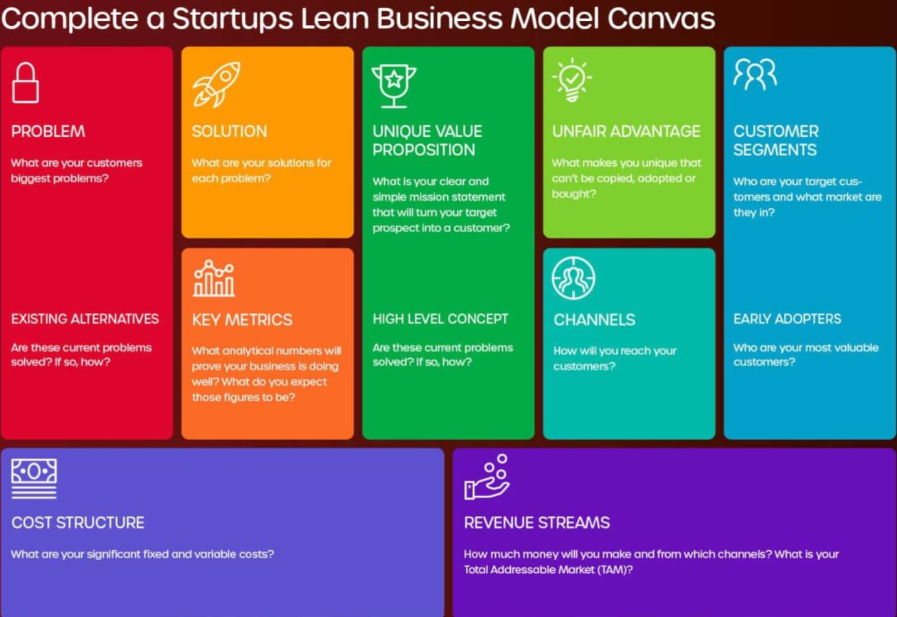
Lean Canvas consists of nine essential building blocks.
Problem
Identify the top problems experienced by your target customers.
Understanding customer pain points is the foundation of product development.
Customer Segments
Define who your customers are.
Different customer groups often have different needs and priorities.
Unique Value Proposition
Clearly explain why customers should choose your product or service.
A strong value proposition highlights the primary benefit offered.
Solution
Outline how your product or service addresses the identified customer problems.
At this stage, simple solutions are often sufficient.
Channels
Identify how customers will discover, purchase, and use your product.
Examples include:
- Websites
- Social media
- Email marketing
- Mobile applications
- Retail stores
Revenue Streams
Describe how the business will generate income.
Revenue sources may include:
- Product sales
- Subscriptions
- Advertising
- Licensing
- Consulting
Cost Structure
List the major expenses involved in operating the business.
Examples include:
- Marketing
- Salaries
- Software
- Manufacturing
- Customer support
Key Metrics
Determine the measurements used to evaluate business success.
Common metrics include:
- Customer acquisition
- Retention
- Revenue growth
- Conversion rate
- Active users
Unfair Advantage
Identify advantages competitors cannot easily copy.
Examples may include:
- Proprietary technology
- Exclusive partnerships
- Brand reputation
- Specialized expertise
- Community loyalty
Lean Canvas Benefits
Lean Canvas provides several advantages for startups and entrepreneurs.
Lean Canvas Simplifies Planning
A single-page format reduces unnecessary complexity.
Lean Canvas Encourages Customer Focus
The framework begins with customer problems rather than products.
Lean Canvas Supports Fast Iteration
Business assumptions can be updated quickly as new information becomes available.
Lean Canvas Improves Communication
Teams can easily understand and discuss business strategies using one visual document.
Lean Canvas Helps Identify Risks
Early identification of assumptions reduces costly mistakes later.
Lean Canvas Example
Imagine a startup creating an online tutoring platform.
A simplified Lean Canvas could include:
Problem:
Students struggle to find affordable tutors.
Customer Segments:
High school and university students.
Solution:
Online tutoring sessions with verified educators.
Revenue Streams:
Monthly subscriptions.
Channels:
Website, mobile app, social media.
Key Metrics:
Student registrations and lesson completion rates.
This example demonstrates how Lean Canvas organizes business ideas efficiently.
How to Create a Lean Canvas
Creating a Lean Canvas involves several straightforward steps.
Step 1
Identify your target customers.
Step 2
Understand their biggest problems.
Step 3
Develop a clear solution.
Step 4
Write your unique value proposition.
Step 5
Define customer acquisition channels.
Step 6
Estimate revenue and costs.
Step 7
Choose measurable success metrics.
Step 8
Identify sustainable competitive advantages.
Review and revise the canvas regularly as customer feedback becomes available.
Lean Canvas Best Practices
To maximize effectiveness:
- Keep information concise.
- Focus on customer problems.
- Validate assumptions with real users.
- Update the canvas frequently.
- Prioritize measurable goals.
- Avoid unnecessary complexity.
Lean Canvas is designed to evolve alongside the business.
Lean Canvas vs Traditional Business Plans
Traditional business plans often contain dozens of pages and extensive financial projections.
Lean Canvas differs by emphasizing:
- Speed
- Flexibility
- Customer validation
- Experimentation
- Continuous improvement
Many startups begin with Lean Canvas before developing detailed business documentation.
Who Should Use Lean Canvas?
Lean Canvas is valuable for:
- Startup founders
- Entrepreneurs
- Product managers
- Innovation teams
- Small business owners
- Students studying entrepreneurship
Its simplicity makes it suitable for organizations of various sizes.
Why Lean Canvas Remains Popular
Modern businesses operate in rapidly changing markets.
Lean Canvas allows entrepreneurs to adapt quickly, validate ideas, and respond to customer feedback without rewriting lengthy business plans. This flexibility has made it one of the most widely used startup planning tools worldwide.
For entrepreneurs, startup founders, and business professionals interested in Lean Canvas, business planning, innovation, entrepreneurship, and startup strategy, editoriala.com provides informative articles that simplify modern business concepts through practical guidance, structured explanations, and easy-to-understand educational content designed for learners at every level.
Final Thoughts
Lean Canvas has become one of the most effective tools for startup planning because it combines simplicity with strategic thinking. By focusing on customer problems, practical solutions, measurable goals, and continuous improvement, it enables entrepreneurs to validate ideas efficiently before making significant investments. Whether launching a new company or refining an existing business model, Lean Canvas offers a structured framework that supports smarter decision-making and sustainable growth.
Frequently Asked Questions
What is Lean Canvas?
Lean Canvas is a one-page business planning framework that helps entrepreneurs organize and validate business ideas.
Who created Lean Canvas?
Lean Canvas was developed by entrepreneur Ash Maurya as a startup-focused adaptation of the Business Model Canvas.
What are the nine components of Lean Canvas?
The framework includes Problem, Customer Segments, Unique Value Proposition, Solution, Channels, Revenue Streams, Cost Structure, Key Metrics, and Unfair Advantage.
Why is Lean Canvas important?
It helps startups quickly identify assumptions, validate business ideas, and improve planning through continuous learning.
Is Lean Canvas only for startups?
No. While widely used by startups, small businesses, product teams, and innovation departments also benefit from the framework.
How often should a Lean Canvas be updated?
Entrepreneurs should revise the Lean Canvas whenever new customer feedback, market insights, or business developments become available.